
In 2024 Weddin Landcare partnered with the Department of Climate Change Energy Environment and Water (DCCEEW) to undertake water quality testing to monitor salinity in the Bland and Tyagong catchments and build capacity in hydrogeological landscapes (HGL) mapping.
The project involved regular electric conductivity (EC) testing at 54 collections points in creeks and flowlines across the Weddin, Hilltops and Bland Shires with localities including Grenfell, Bumbaldry, Greenethorpe, Bimbi, Quandialla, Stockinbingal and Monteagle.
The data collected by Weddin Landcare feeds into a broader project with Murrumbidgee, Harden-Murrumburrah, Mid-Lachlan, Little River and Mid-Macquarie Landcare groups monitoring seven other catchment areas across a large area from Wagga Wagga to Dubbo.
Valuable water quality information has been collected and is informing DCCEEW and Landcare’s understanding of salinity processes and the impacts at a local and catchment scale.
“We have seen an increase in requests for assistance with saline land issues on farms across a large area in Central West and Southern NSW. Old saline sites are getting larger and new sites are appearing,” said Andrew Wooldridge, Salinity Technical Officer at the Basin Salinity Program, DCCEEW.
“Around Weddin Landcare the data is showing significant salinity in the Tyagong, Cudgell and Burrangong Creeks. Landholders are also reporting new and expanding saltland sites on farms – particularly in areas where winter cereal cropping has been done for several years in a row,” Andrew Wooldridge adds.
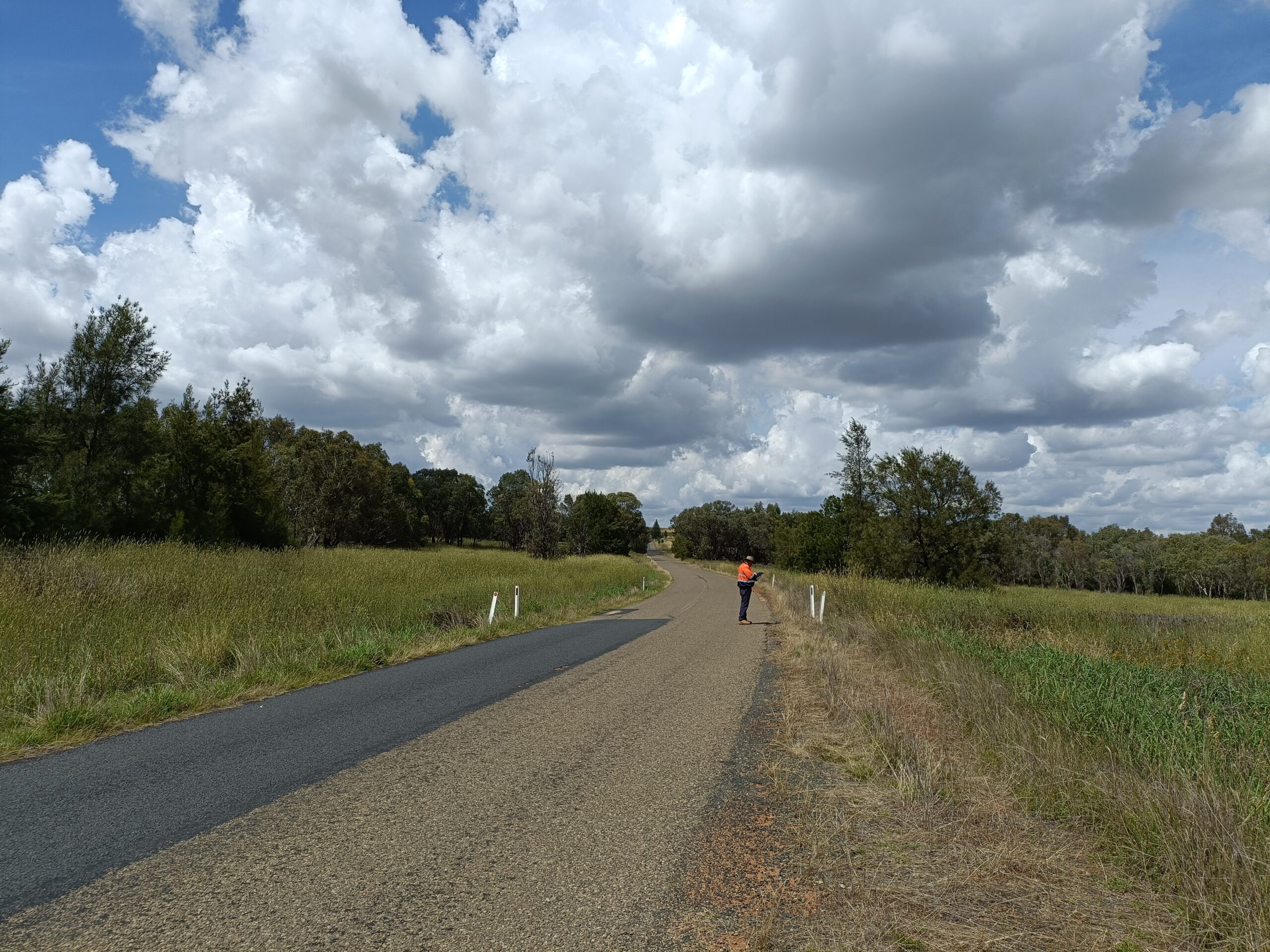
Andrew Wooldridge ispecting an old salinty site in Greenethorpe, NSW.
Over the lifecycle of this project, measurements from the Tyagong Creek has an average of 3,238 EC, Cudgell Creek has an average of 2,684 EC and Burrangong Creek has an average of 3,238 EC. To put this in perspective, the maximum level for human consumption should not exceed 950 EC. At 1,500 EC freshwater plants and animals begin to be impacted leading to stress and decrease in biodiversity. Once levels reach over 3,500 EC the water can be harmful to pregnant livestock leading to dehydration, stress and other health issues.
“Salinity in our landscapes is certainly something to keep an eye on. Unfortunately, there isn’t a quick fix for landholders that are being impacted. We have learnt that there are many areas where the geological landscape is more prone to pushing ground water up to the surface. It’s not really something that ever goes away, but it can be managed,” Claire Diprose, Local Landcare Coordinator, Weddin Landcare said.
Issues with salinity are often uncovered with changed land use or an increase in clearing. Common signs of an under lying salinity issue could be a reduced crop yield, soggy or bare patches, puffy soil and changes in the plant species that persist.
“The recommended solutions are working with the land profile. Areas that are more susceptible to salinity can still be productive as perennial pasture, fodder and shelter for livestock. Ground cover and salt tolerant trees help; a large paddock tree can transpire around 100 litres a day so they do a great job of absorbing a lot of excess moisture in the soil and ground covers stop salt from solidifying on the surface, making soil conditions more conducive for other plants to grow,” Claire Diprose adds.
With the project due to wrap up in April, Andrew Wooldridge is developing a mobile app to hold soil and water data across Central West NSW with the idea that landholders and national resource managers will be able to add their own landscape observations and see updates of salinity levels in their region.
If you would like to read more about the project, you can find maps and data here. If you have any questions about salinity on your property, get in touch on 0493 416 442 or weddinlandcare1@outlook.com.