
In 2024 Weddin Landcare partnered with the Department of Climate Change Energy Environment and Water to undertake water quality testing to monitor salinity in the Bland and Tyagong catchment and build capacity in hydrogeological landscapes mapping (HGL).
The data collected by Weddin Landcare feeds into a broader project with Murrumbidgee, Harden Murrumburrah, Mid Lachlan, Little River and Mid Macquarie Landcare groups monitoring 7 other catchment areas across a large area from Wagga Wagga to Dubbo. After each collection, the data is provided to Andrew Wooldridge, Salinity Technical Officer at the Basin Salinity Program, Department of Climate Change, Energy, Environment and Water.
Weddin Landcare has split the collection points into two loops to cover the catchment with a total of 54 sample points covering a total distance of approximately 570km.
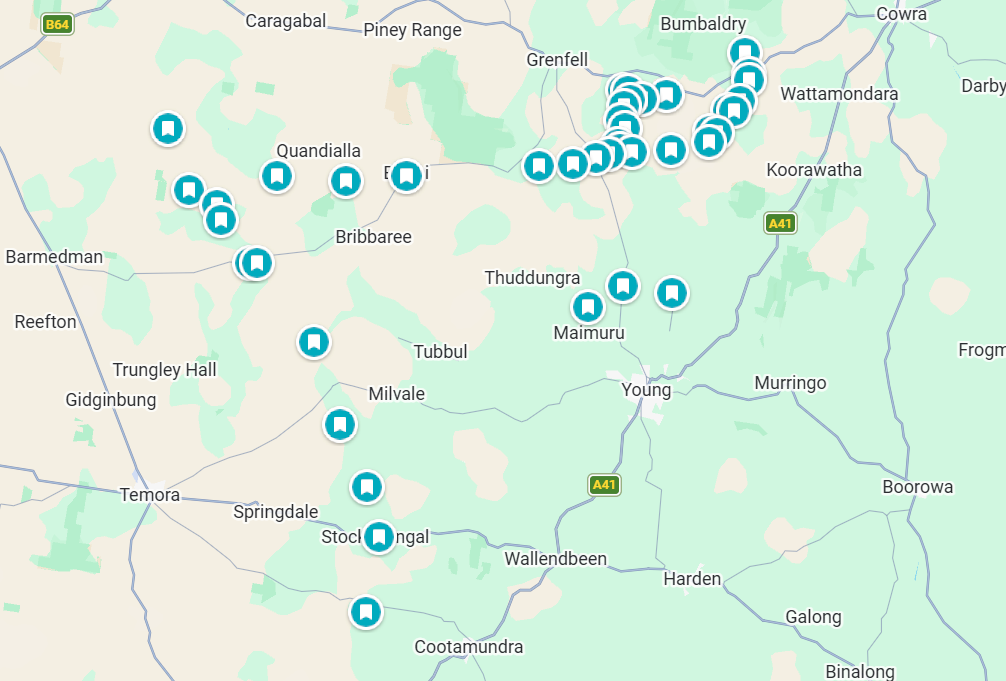
Collection points across the Tyagong and Bland catchment area. Image from Google Maps.
Water sampling is completed using electric conductivity (EC) testing. EC testing measures the speed at which electricity passes between two electrodes through soil or water. The EC of a sample is affected by the concentration and composition of dissolved salts. As salts enhance the solution’s capacity to conduct electricity, a higher EC value signifies elevated salinity levels.
Interpreting the data
950 EC is the maximum level for human consumption.
1500 EC is when freshwater plants and animals begin to be impacted, leading to stress and a decrease in biodiversity.
3500 EC is when the water can be harmful to pregnant livestock, leading to dehydration, stress and other health issues.
50000 EC is seawater!
The fluctuation of salinity levels is influenced by the continuous changes in the system. Rainwater and runoff serve to dilute the system, resulting in lower salinity levels, while evaporation raises salinity through concentration. Additionally, seasonal and climatic events, along with the ongoing activities across the landscape, play significant roles in these variations.
Tyagong Loop
The Tyagong loop covers a distance of approximately 190 km across Bumbaldry, Greenethorpe, and Grenfell.
- 27 sample points
- 6 water systems – Tyagong Creek, Bumbaldry Creek, Kellys Creek, Brundah Creek, Bungalong Creek and Murray’s Creek.
- Data Points: https://maps.app.goo.gl/qHuRi3cFMxmMfvSw7
Below are the figures from 10 sample points with consistent data from 2024 to 2026.
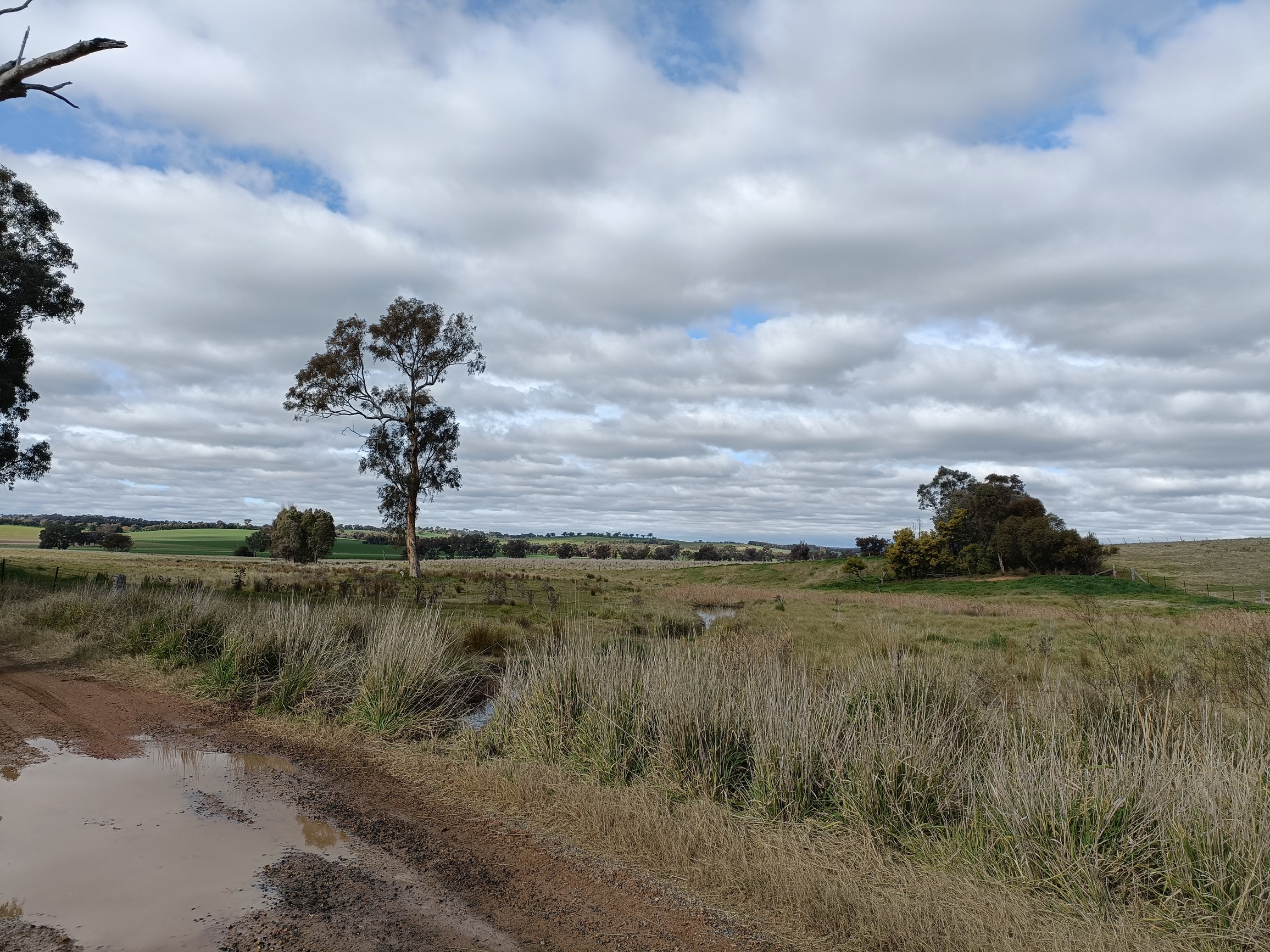
Tyagong Creek at Wilsons Lane, Greenethorpe
| # | Creek | Sample point | Jul 2024 | Oct 2024 | Dec 2024 | Jan 2025 | Jun 2025 | Jan 2026 |
| 6 | Tyagong | Bumbaldry Rd | 3000 | 2530 | 2060 | 4060 | 3650 | 4950 |
| 7 | Kellys | Wilsons Ln | 4500 | 4850 | 4730 | 5750 | 5300 | Dry |
| 8 | Tyagong | Wilsons Ln | 2900 | 2360 | 2140 | 3580 | 3580 | 4010 |
| 10 | Tyagong | Gambarra Rd | 3400 | 2780 | 2720 | 4220 | 3840 | 4270 |
| 13 | Tyagong | Gerrybang Rd | 3300 | 2450 | 2530 | 4240 | 3580 | Dry |
| 14 | Brundah | Newmans Ln | 6400 | 5300 | 1480 | 6350 | 3700 | 2300 |
| 15 | Brundah | Bobelar Ln | 600 | 2620 | 1480 | 3480 | 1380 | n/a |
| 16 | Bungalong | Brundah Hall Rd | n/a | 4700 | 2320 | Dry | 5300 | n/a |
| 21 | Bungalong | Wirega G/thorpe Rd | n/a | 4460 | 2360 | Dry | 4380 | n/a |
| 27 | Tyagong | Old Forbes Rd | 3400 | 3400 | 1460 | 4030 | 3680 | Dry |
Bland Loop
The Bland loop covers approximately 380 km across Grenfell, Bimbi, Quandialla, Stockinbingal and Monteagle.
- 27 sample points
- 11 water systems – Emu Creek, Tyagong Creek, Burrangong Creek, Bland Creek, Bribbaree Creek, Narraburra Creek, Wattle Retreat Flowline, Cudgell Creek, Bulla Creek, Ten Mile Gully flowline and Duffer Gully flowline.
- Data Points: https://maps.app.goo.gl/DariYSJscV4GFuz57
Below are the figures from 10 sample points with consistent data from 2024 to 2026.
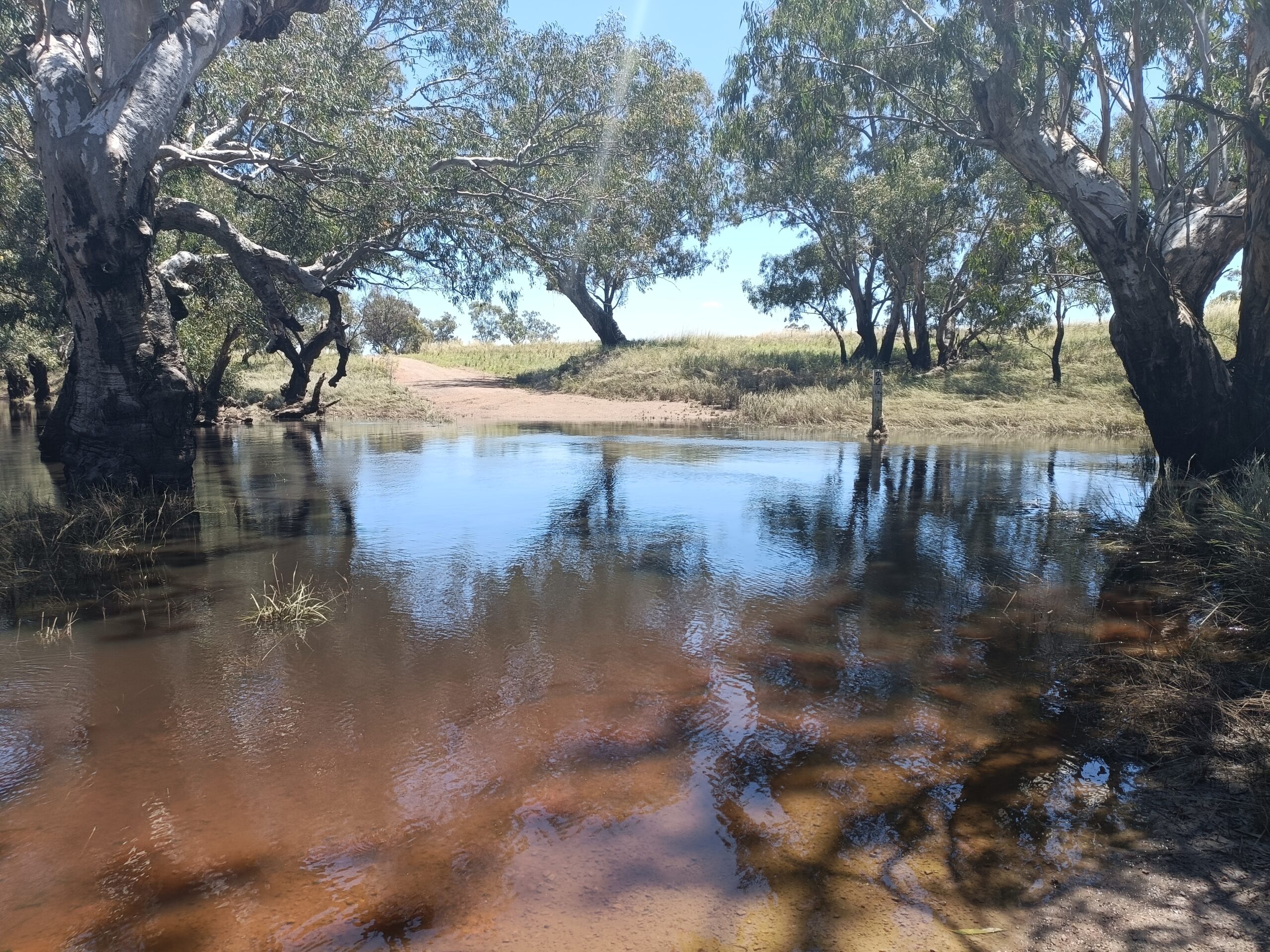
The Bland Creek at Quandialla Road, Quandialla
| # | Creek | Sample point | Jul 2024 | Oct 2024 | Dec 2024 | Jan 2025 | Jun 2025 | Jan 2026 |
| 2 | Emu | Old Forbes Rd | 2540 | 1760 | 490 | Dry | 6090 | Dry |
| 4 | Burrangong | Old Forbes Rd | 1880 | 1910 | 1430 | 2000 | 1900 | Dry |
| 7 | Burrangong | Troths Ln | 2300 | 2470 | 1020 | 4201 | Dry | n/a |
| 9 | Bland | Quandialla Rd | 2000 | 2310 | 470 | 1610 | 2120 | n/a |
| 12 | Bribbaree | Moonbucca Rd | 300 | 320 | 250 | 59 | Dry | n/a |
| 14 | Narraburra | Mary Glimore Way | 200 | 210 | 240 | 450 | Dry | n/a |
| 16 | Bland | Milvale Rd | 2100 | 2330 | 640 | 1510 | 1080 | n/a |
| 21 | Cudgell | Quamby Rd | 2500 | 2670 | 2230 | 2800 | 3040 | 2470 |
| 23 | Burrangong | Monteagle SR West | 1600 | 1650 | 1410 | 1830 | 1740 | 2030 |
| 24 | Bulla | Monteagle SR West | n/a | 4330 | 2780 | 7020 | 6120 | Dry |
Indicators of salinity
Common signs of an underlying salinity issue could be a reduced crop yield, soggy or bare patches, puffy soil and changes in the vegetation.
Want to know more about this project? Get in touch on 0493 416 442.